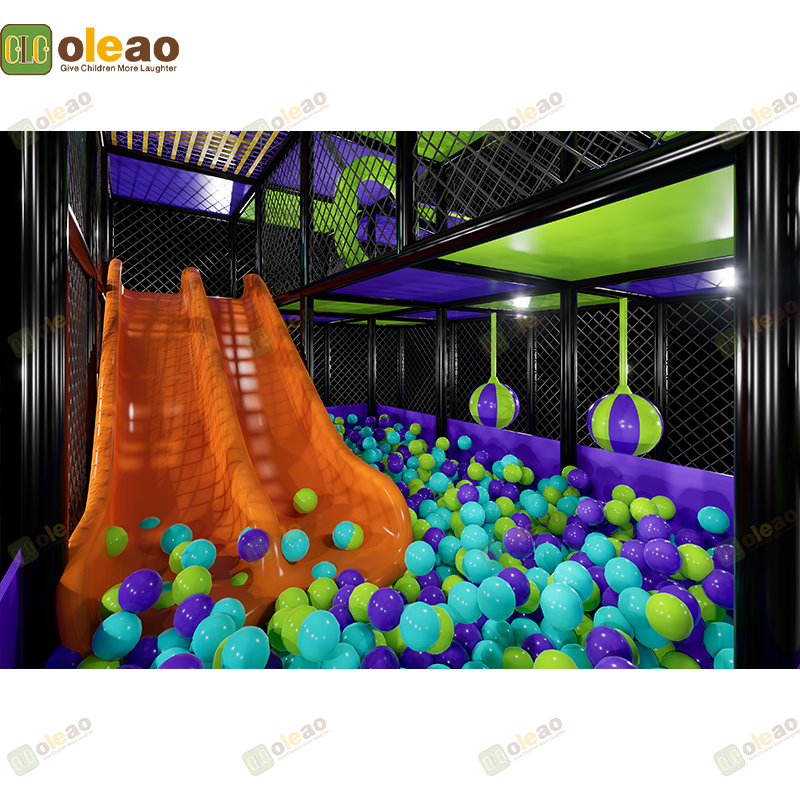
Ball pools are one of the most recognizable features in soft play zones. For children, they feel colorful, soft, and exciting. For operators, they provide more than visual appeal. A well-planned ball pool can improve movement value, sensory experience, social interaction, and the overall play structure of a soft play area.
In commercial indoor play venues, ball pools are especially useful for younger children. They create a lower-intensity activity space where toddlers and preschool children can crawl, roll, reach, explore, and interact in a controlled environment.
When combined with soft play equipment, slides, foam blocks, tunnels, and low climbing elements, a ball pool can become an important part of a complete early-childhood play system.
1. Physical Development Benefits
Ball pools help children move actively without requiring high-speed or high-impact play. This makes them especially suitable for soft play zones designed for toddlers and younger children.
Enhancing Gross Motor Skills
When children crawl, walk, roll, or push through a ball pool, they use large muscle groups in the arms, legs, shoulders, and core. The shifting balls create gentle resistance, so children need to work harder to move forward and maintain body control.
This type of movement supports gross motor development. Children practice crawling, reaching, balancing, stepping, and changing direction in a playful environment. For young children who are still building confidence in movement, a ball pool provides a soft and engaging way to stay active.
For venues that serve toddlers, a ball pool can work well with a toddler soft play area, creating a safer movement zone with lower height, softer materials, and easier supervision.
Improving Coordination and Balance
A ball pool is not a flat surface. The balls move under the child’s body, which encourages constant adjustment. Children need to coordinate their hands, feet, eyes, and body position as they move through the pool.
This helps improve balance, spatial awareness, and body control. Simple actions such as reaching for a ball, standing up, sitting down, or moving toward a slide exit can help children practice coordination in a natural way.
For operators, this adds developmental value to the soft play zone. The ball pool is not only a decorative feature; it supports movement learning through safe instability and controlled exploration.
2. Sensory Stimulation Value
Soft play zones often serve young children who learn through touch, color, movement, and repeated sensory exploration. Ball pools support this type of learning very effectively.
Visual and Tactile Engagement
The bright colors of ball pools attract children’s attention and make the play area feel more inviting. Children can recognize colors, follow moving balls, sort them, or use them in simple games.
The tactile experience is also important. Children touch, grab, squeeze, push, and move through the balls. The smooth surface, light weight, and shifting pressure create continuous sensory feedback.
For younger children, this combination of visual and tactile stimulation supports curiosity and exploration. It also makes the soft play zone feel more interactive than a static padded area.
Supporting Sensory-Friendly Play
Some children need gentler and more controlled sensory environments. A ball pool can provide soft pressure, repeated movement, and predictable tactile input, which may help children feel more comfortable during play.
This does not mean every ball pool should be treated as a therapy space. However, from a play design perspective, ball pools can support sensory-friendly activity when the depth, size, color, entry point, and supervision are properly planned.
For commercial venues, this can make the soft play area more inclusive and more appealing to parents looking for calmer, safer play options for younger children.
3. Social Interaction in Ball Pools
Ball pools naturally encourage shared play. Children enter the same space, move around each other, exchange balls, copy actions, and create simple group games.
Encouraging Cooperative Play
In a ball pool, children learn to share space. They may take turns sliding into the pool, search for specific colors together, toss balls into baskets, or play simple hide-and-find games.
These activities support patience, cooperation, and early social awareness. Children learn that their movement affects others, which helps them practice safer and more considerate behavior.
For family entertainment centers and kids activity rooms, this social value matters. Parents often prefer play spaces where children are not only entertained but also learning how to interact with others.
Developing Communication Skills
Ball pools also create many opportunities for communication. Children may ask for a ball, invite a friend to play, describe colors, or follow simple instructions from parents or staff.
Nonverbal communication also appears during play. Children watch facial expressions, gestures, movement, and reactions from others. These interactions help build early communication habits and social confidence.
When staff or parents guide simple games, the ball pool can become a useful space for group activity, not just free play.
4. Cognitive Development and Early Learning
Ball pools can support early learning when they are used with simple, age-appropriate activities. The key is to keep learning playful rather than formal.
Problem-Solving and Spatial Awareness
Moving through a ball pool requires children to understand space and movement. They need to figure out how to crawl forward, how to stand up, how to reach a ball, or how to move around another child.
These small challenges support problem-solving and spatial awareness. Children learn through trial and error, adjusting their movement based on how the balls shift around them.
This is especially useful in soft play design because young children need activities that combine movement, thinking, and safe exploration.
Color Recognition and Counting Games
Ball pools are also useful for simple early learning games. Children can find red balls, collect three blue balls, sort colors, or count how many balls they can place into a small basket.
These activities support color recognition, counting, matching, memory, and attention. They also give parents and staff easy ways to interact with children during play.
For operators, this means the ball pool can support both open play and guided activity programming, especially in parent-child centers, toddler rooms, and daycare-related play spaces.
5. Safety and Hygiene Considerations
Ball pools can add strong value to soft play zones, but they also require careful safety and hygiene management. A poorly maintained ball pool can quickly affect parent trust and the overall image of the venue.
Maintaining a Clean Play Environment
Ball pools should have a clear cleaning routine. Operators need to regularly clean the balls, base area, surrounding padding, and entry points.
Important hygiene practices include:
Regular ball washing or sanitizing
Removing damaged, dirty, or cracked balls
Cleaning the pool base and surrounding soft surfaces
Encouraging hand cleaning before and after play
Keeping food and drinks away from the play area
Inspecting the area for small objects or debris
For commercial soft play operators, hygiene is not only a maintenance task. It is part of the customer experience. Parents are more likely to trust a venue when the ball pool looks clean, organized, and well managed.
Safety Features of Ball Pools
A safe ball pool should match the age group and usage level of the venue. Important details include soft padded walls, rounded edges, non-toxic materials, suitable ball size, proper depth, secure entry and exit points, and clear visibility for supervision.
For toddler areas, the ball pool should not be too deep or difficult to exit. Parents and staff should be able to see children clearly. Entry points should be stable and easy for young children to use.
Safety planning should also consider how the ball pool connects with other equipment. If it is placed under a slide, the landing area needs enough space and proper padding. If it is connected with climbing blocks or tunnels, the movement route should be easy to supervise.
Early 3D layout planning can help operators review ball pool placement, entry direction, supervision angles, and surrounding activity flow before production.
6. Customization and Space Planning
Ball pools should be designed according to the real space, target users, theme, and operating model of the venue. A ball pool that works well in a toddler center may not be suitable for a larger family entertainment center.
Designing a Ball Pool to Fit the Space
For small soft play rooms, compact or modular ball pools may be more practical. They can be combined with low slides, foam steps, soft tunnels, or small climbing blocks to create a complete toddler activity corner.
For larger venues, ball pools can become part of a stronger visual and activity zone. They may connect with slides, bridges, themed soft play structures, or multi-zone indoor playground layouts.
A product solution such as commercial soft play equipment with ball pit routes shows how ball pools can be integrated with soft blocks and movement routes rather than treated as isolated features.
The goal is not simply to make the ball pool bigger. The goal is to make it easier to enter, safer to supervise, more interesting to use, and better connected with the rest of the soft play zone.
Choosing Themes and Colors
Color and theme design affect how children and parents perceive the play space. Bright colors can create energy and excitement, while pastel tones may feel softer and more suitable for toddlers.
Themes such as ocean, forest, candy, city, animals, or fantasy play can make a ball pool more memorable. For commercial venues, theme consistency also helps improve the visual identity of the soft play zone.
A themed product direction such as animal theme soft play equipment can make the ball pool feel like part of a complete environment, not just a container filled with balls.
7. Operational Value for Soft Play Venues
From a business perspective, ball pools help soft play zones become more attractive and easier to use for young children. They offer a familiar activity that parents recognize and children understand quickly.
A well-designed ball pool can support:
Longer toddler engagement
Parent-child interaction
Low-intensity active play
Photo-friendly visual appeal
Simple group games
Better zoning inside the play area
Stronger value for daycare, mall, restaurant, and kids room projects
For operators, the ball pool should be planned as part of the whole soft play experience. It should connect with other zones, support safe movement, and fit the venue’s maintenance capacity.
FAQ
What is a ball pool in a soft play zone?
A ball pool is a padded play area filled with lightweight plastic balls. It allows children to crawl, roll, sit, reach, explore, and play in a soft, colorful environment.
Why do soft play zones need ball pools?
Ball pools add movement value, sensory stimulation, social interaction, and early learning opportunities. They also make soft play zones more attractive and suitable for younger children.
How do ball pools support physical development?
Children use their arms, legs, core, balance, and coordination when moving through a ball pool. The shifting balls create gentle resistance and encourage active movement.
Are ball pools suitable for toddlers?
Yes, but the design must be age-appropriate. Toddler ball pools should use suitable depth, safe ball size, soft padding, easy entry, clear visibility, and close supervision.
How should operators maintain ball pools?
Operators should clean balls and surfaces regularly, remove damaged balls, keep food and drinks away, check for small objects, and maintain clear inspection routines.
Soft Play Planning Notes
Ball pools are important in soft play zones because they support more than simple entertainment. They add active movement, sensory exploration, social play, early learning, and visual appeal within a child-friendly environment.
For a small toddler room, a compact ball pool connected with a low slide or soft blocks may be enough to create strong play value. For larger commercial venues, the ball pool can become part of a themed soft play system with slides, tunnels, climbing modules, and parent viewing areas.
The best result comes from balancing play value, safety, hygiene, supervision, theme design, and maintenance practicality. A ball pool should not be added only because it looks popular; it should fit the overall soft play layout and operating model. For more commercial soft play planning ideas and equipment solutions, visit Aoleao.


 English
 العربية
 Français
 Русский
 Español
 Português
 Deutsch
 italiano
 日本語
日本語 한국어
한국어 Nederlands
 Tiếng Việt
 ไทย
ไทย Polski
 Türkçe
 አማርኛ
አማርኛ ພາສາລາວ
 ភាសាខ្មែរ
 Bahasa Melayu
 ဗမာစာ
ဗမာစာ தமிழ்
தமிழ் Filipino
 Bahasa Indonesia
 magyar
 Română
 Čeština
 Монгол
 қазақ
қазақ Српски
 हिन्दी
 فارسی
فارسی Kiswahili
 Slovenčina
 Slovenščina
 Norsk
Norsk Svenska
 українська
 Ελληνικά
 Suomi
Suomi Հայերեն
 עברית
עברית Latine
 Dansk
Dansk اردو
اردو Shqip
Shqip বাংলা
বাংলা Hrvatski
 Afrikaans
 Gaeilge
 Eesti keel
 Māori
Māori